
All-Clad vs Demeyere: Which Cookware Is Better in 2026?
Choosing between premium cookware brands can feel overwhelming—especially when both options promise excellent performance, durability, and long-term value. If you’ve narrowed your choice down to All-Clad vs Demeyere, you’re already looking at two of the best stainless steel cookware brands in the world.
But here’s the truth:
They are not the same—and one will fit your cooking style much better than the other.
This guide will walk you through everything you need to know in a simple, honest way. No fluff. No confusing terms. Just real insights to help you choose the right cookware for your kitchen.
Quick answer (for skimmers)
If you want a short, honest take: All-Clad is the best choice for most home cooks. It offers excellent performance, is lighter and easier to handle, and gives strong value for the price.
Demeyere is the better tool if you’re a performance-focused cook who wants the absolute best heat retention, the easiest cleanup, and is willing to pay more and handle heavier pans.
Both brands are excellent — it comes down to use case, budget, and how much weight in the hand matters to you.
Quick comparison table: All-Clad vs Demeyere
| Feature | All-Clad | Demeyere |
| Weight (general) | Medium — easier to lift | Heavy — feels professional |
| Heat distribution | Very good | Excellent |
| Heat retention | Very good | Superior |
| Ease of cleaning | Good (rivets trap food) | Excellent (smooth interiors) |
| Induction performance | Compatible | Exceptional |
| Best for | Everyday home cooks | Serious cooks, induction users, long-simmering dishes |
Who are these brands for?
Both brands target cooks who want long-lasting, high-performing stainless-steel cookware, but they approach that goal differently.

All-Clad is designed to be approachable. It’s made for home cooks who want pro-level results without pro-level cost or heft. All-Clad pans heat evenly, respond well to temperature changes, and are lighter than many premium alternatives. If you’re upgrading from cheap nonstick pans or want cookware that does almost everything well without being exhausting to lift, All-Clad is built for you.

Demeyere is engineered for performance. It’s a Belgian brand known for heavy-duty construction, advanced multilayer technology, and finishes that resist staining and sticking. Demeyere shines for people who cook often, use induction cooktops, or prepare seared meats and reductions that demand even, sustained heat. It’s also a favorite where cleaning speed is important — the smooth interiors and fewer rivets make post-cook scrubbing easier.
What makes stainless steel cookware “good”?
Before we dive deeper, it helps to be clear about what actually matters in stainless-steel cookware. If you understand these basics, the differences between brands become more meaningful.
- Heat distribution — how evenly the pan spreads heat. Poor distribution creates hot spots and uneven browning.
- Heat retention — how well the pan holds temperature when food is added. Good retention keeps the sear going and reduces recovery time.
- Responsiveness — how quickly a pan changes temperature when you adjust the burner. Faster responsiveness helps with delicate temperature work.
- Durability & finish — resistance to warping, staining, and long-term wear. Some finishes also make cleaning easier.
- Weight & balance — affects comfort, especially when lifting full pans or moving between burners and oven.
- Compatibility — works well on your cooktop (gas, electric, induction) and suits your oven use.
Knowing which of these you value most makes the comparison practical: some cooks prefer fast responsiveness; others want rock-steady heat and low-maintenance cleanup.
Performance comparison (real cooking tests)
Numbers and marketing matter, but what matters most is how these pans behave on the stove. Below are hands-on performance tests you can use to evaluate any stainless pan, along with what to expect from each brand.
Heat distribution
Heat distribution means how evenly a pan spreads heat across its cooking surface. Uneven heat causes hot spots that burn food. In practice, both brands are designed to distribute heat well thanks to multi-layer cladding, but there are subtle differences.
All-Clad (especially in the D3 and D5 lines) uses full cladding of aluminum between stainless layers to create quick, even heating across the base. That makes All-Clad great for routine cooking: sautéing vegetables, pan-frying, and simmering sauces.
Demeyere adds extra engineering to the mix. Its patented constructions and thicker base materials help heat spread evenly and — importantly — hold that heat. On a burner, Demeyere won’t cool down as quickly when you add cold ingredients, which helps when you’re searing or want steady simmering.
Searing performance
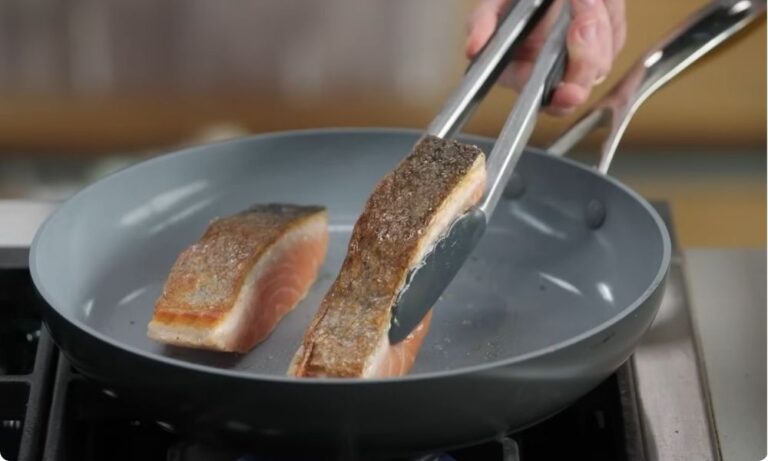
When you sear steak or pork, you want a pan that takes and holds heat. Demeyere’s superior heat retention gives it an edge here. It forms a better crust faster and holds temperature when you add a cold steak, giving more consistent browning without losing heat.
All-Clad still sears excellently. For home use, the difference is often modest, but if you’re doing repeated heavy searing (multiple steaks in a row) Demeyere will keep a more consistent surface temperature and require less recovery time between pieces.
Heat control and responsiveness
Responsiveness is how quickly a pan reacts to temperature changes. A responsive pan lets you quickly reduce a simmer or cool down a sauce. All-Clad’s lighter construction often makes it more responsive: it heats up and cools down faster, which some cooks prefer for delicate work. Demeyere trades a bit of responsiveness for stability — it resists temperature swings, which is fantastic when you need steady, even heat for sauces, reductions, or long braises.
Practical takeaway: if you need quick temperature changes (custards, delicate sauces), All-Clad’s responsiveness is a plus. If you want rock-steady heat for searing or reducing sauces, Demeyere’s retention is superior.
Build quality & construction
Construction influences heat, handling, and cleaning.
Cladding explained (simple)
Cladding is the bonding of layers (usually stainless and aluminum) so the pan benefits from stainless’s durability and aluminum’s heat conduction. Full cladding means layers run up the sides as well as the base; disc or bonded-base cladding only covers the bottom. Full cladding gives more even side-wall heating and is generally preferred for versatile, consistent performance.
All-Clad construction
All-Clad’s D3 (3-ply) and D5 (5-ply) are the most common. D3 is lighter and responsive — a great general-purpose design. D5 adds more layers for steadier heat and reduced hot spots. Handles are typically riveted; rivets are sturdy but create small crevices that can trap food.
Demeyere construction
Demeyere uses several proprietary constructions across its lines (Industry 5, Atlantis, etc.). Many pieces use welded handles and finishes designed to reduce sticking and discoloration. Welded handles create a smoother interior surface than rivets, which helps cleaning and reduces food traps. Demeyere also often uses thicker multi-layer bases to improve retention and stability.
Safety & stability (warping and oven use)
Both brands are built to resist warping under normal use. Demeyere’s heavier base gives it an edge for resisting warpage under high, sustained heat. Both are typically oven-safe to high temperatures, but always check the specific line and handle materials before broiling or using extremely high oven temps.
Product lines & options (practical guide)
If you want to pick a model, here’s a short guide:
- All-Clad D3 — Best for most cooks: lighter, responsive, great price/performance.
- All-Clad D5 — Heavier, more stable heat for those who want extra evenness.
- Demeyere Industry 5 — A lighter, less-expensive Demeyere option; good middle ground.
- Demeyere Atlantis — Premium line with thick bases, Silvinox finish on many pieces, welded construction; best for serious cooks who want low-maintenance upkeep.
If you’re unsure, buy a single skillet in the line you’re curious about and see how it fits your routine before committing to a full set.
Ease of cleaning & maintenance
Nobody likes scrubbing pans. Cleaning differences are practical and can affect daily convenience.
All-Clad has a bright stainless interior that cleans well if food doesn’t get burned. However, riveted handles can trap grime and take extra effort to clean thoroughly. Many cooks are able to toss All-Clad in the dishwasher, but repeated dishwasher use may dull finishes over many years.
Demeyere’s welded handles and special finishes (such as Silvinox on some lines) make cleaning easier. Silvinox is a surface treatment that keeps stainless looking bright and resists buildup. With fewer nooks and a smoother interior, burnt food often comes off more easily. That means less elbow grease and fewer harsh scrubbing sessions.
Tip: Regardless of brand, avoid high-heat empty-pan burnout, soak stuck-on food promptly, and use a soft scrubber or baking soda paste for tough spots. If you value minimal cleanup time, Demeyere’s designs tend to make life easier.
Weight & comfort (very important)
Weight affects how often you use a pan and how comfortable you feel while cooking.
All-Clad tends to be lighter and easier to move around. If you cook for one or two, or you frequently lift full pans, All-Clad’s feel can be a decisive advantage.
Demeyere tends to be heavier. For many cooks, that heft signals quality and provides steady heat; for others it can be tiring. Consider your strength and how often you’ll be maneuvering the pan.
Design & ergonomics
A few small design details make everyday cooking easier: handle shape, balance, pouring rims, and lid fit.
- Handles: All-Clad’s riveted handles are sturdy and comfortable, but the rivets can add cleaning work. Demeyere’s welded handles provide a seamless interior and a smooth feel, which many cooks appreciate.
- Balance: Try to test the pan if possible. A well-balanced pan should feel natural to lift even when full.
- Pouring rims & lids: Small things like a drip-free pour or a lid that seals without rattling make daily life nicer. Check lids for weight and fit when picking a model.
Compatibility & versatility
Modern kitchens differ: gas, electric, and induction cooktops require different approaches.
Both brands offer induction-compatible lines, but Demeyere’s design is particularly well-matched to induction cooking. Their heavier, highly conductive bases take full advantage of induction’s rapid heating and maintain consistent temperatures.
Both brands are oven-safe to high temperatures, generally safe for broiling and oven finishing. Always check specific model limits for oven-safe temperature and handle materials. Most All-Clad and Demeyere items tolerate oven heat that suits searing-then-roasting recipes.
Dishwasher safety varies by series, but hand-washing is often recommended to preserve gloss and extend product life. Demeyere’s finishes tend to fare better under dishwasher use, but I still recommend hand-washing for best long-term results.
Price vs value (long-term investment)
The price is real. Both brands are premium, so it helps to think in terms of cost per year rather than sticker shock.
All-Clad offers a lower starting point for premium stainless-steel cookware. For many home cooks, it’s the best balance of price and performance: high-quality results without an extremely high upfront cost.
Demeyere comes with a higher price tag. The question is whether that additional investment pays off for you. If you cook several times a week, particularly searing, braising, or using induction, the performance gains — better heat retention, easier cleaning, and professional handling — can justify the cost. Demeyere often lasts for decades. If you view cookware as a long-term investment, the cost-per-year can look favorable.
A simple cost-per-year thought experiment: if an All-Clad pan runs half the price of a Demeyere pan and both last 20 years, the annual cost difference shrinks. But if you use the pan many nights weekly and value the specific performance differences, the extra upfront cost may be worth it.
Real-world use cases
The right cookware depends on what you cook most. Below are common scenarios and which brand fits best.
Everyday meals, quick sautés, eggs, vegetables
All-Clad is ideal. It heats quickly, is lighter, and is forgiving for routine tasks. If you want pro results with minimal extra effort, All-Clad will likely satisfy you.
Frequent searing, steaks, and pans used back-to-back
Demeyere is better. Its heat retention reduces recovery time between sears and helps maintain a steady crust on meat.
Long, gentle reductions or delicate sauces
This is a toss-up with nuance. Demeyere’s stability is helpful for even simmering; All-Clad’s responsiveness is helpful for delicate temperature changes. If you make reductions that require long, steady heat, Demeyere has the advantage.
Induction cooking
Both work, but Demeyere is optimized for induction and often outperforms lighter pans in heat consistency on these cooktops.
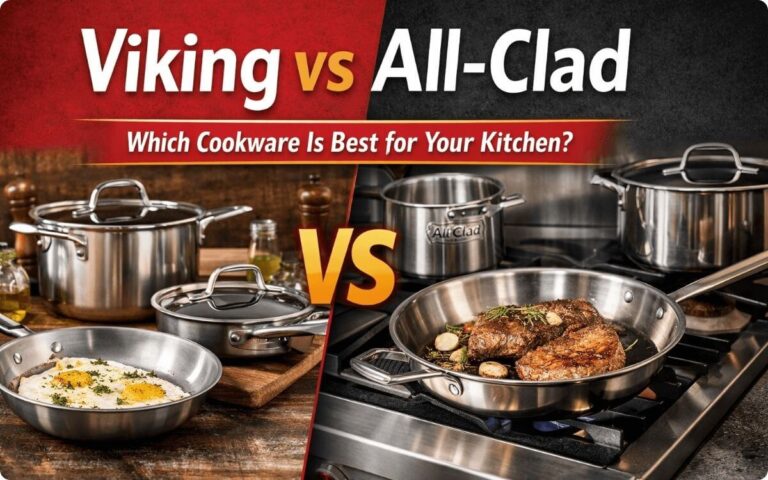
Read More: Viking vs All-Clad: Which Cookware Is Better?
Busy households and quick cleanup
Demeyere’s smooth interiors and finishes make cleanup faster and easier, which can be a daily time-saver.
Pros and cons
Below is a direct look at strengths and weaknesses to help you decide quickly.
Pros and Cons of All-Clad
Pros
- Lighter and easier to handle.
- Strong performance for most home cooking.
- More accessible price point for premium stainless.
- Responsive to temperature changes.
Cons
- Riveted handles can trap food.
- Slightly less heat retention than the heaviest premium lines.
Pros and Cons of Demeyere
Pros
- Outstanding heat retention and distribution.
- Smooth interiors and finishes that clean more easily.
- Excellent induction performance.
- Built to last; premium engineering.
Cons
- Heavier — can be tiring for some cooks.
- Higher price point.
Which should you buy? (decision guide)
Choosing the right pan is about how you cook, not the brand name. Use these decision rules:
Choose All-Clad if:
- You cook for yourself, a partner, or a small family and want great results with less effort.
- You prefer lighter cookware that’s easier to handle.
- You want premium performance but are price-conscious.
- You favor quick temperature changes for delicate cooking.
Choose Demeyere if:
- You cook frequently and prioritize searing, reductions, and induction performance.
- You want the easiest cleanup and a smooth interior.
- Weight doesn’t bother you and you value the highest possible stability.
- You’re comfortable paying more for marginal performance gains and engineering.
If you can, test the weight and handle the feel in a store. If buying online, check weight specs and be realistic about daily use.
Read More: All-Clad vs Cuisinart (Complete Guide)
Conclusion
For the average home cook, All-Clad offers the best balance of price, weight, and kitchen performance. If you want strong results every night without lugging heavy cookware, All-Clad is the sensible pick.
If you cook often, sear a lot of meat, run induction, or simply hate scrubbing pans, Demeyere’s premium engineering and finishes are worth the premium. It’s a tool for cooks who prioritize thermal stability and low maintenance.
Either brand will serve you well — choose based on how you cook, how often you use your pans, and which trade-offs you’re willing to make.
FAQs
Is Demeyere better than All-Clad?
“Better” depends on the metric. Demeyere typically wins on heat retention and cleaning ease; All-Clad is lighter and offers great value. For most home cooks, All-Clad is the practical winner. For performance-focused cooks, Demeyere is the top pick.
Why is Demeyere more expensive?
Demeyere uses thicker, more complex multi-layer constructions, welded handles, and special finishes that increase both manufacturing complexity and long-term durability. These factors justify a higher price for buyers seeking those traits.
Does All-Clad last forever?
No cookware lasts forever, but All-Clad is built to last many years — often decades with proper care. If you treat it well (no overheating empty pans, avoid abrasive cleaners), it will serve for a very long time.
Which is better for induction?
Both brands offer induction-compatible lines, but Demeyere is especially well-suited to induction due to its heavier, highly conductive base construction.
Is a welded handle better than riveted handles?
Welded handles create a smoother interior and can be easier to clean. Riveted handles are extremely sturdy, but the rivet junctions can trap food. Both are durable; welded handles edge out slightly for cleaning convenience.