All Clad D3 vs D5: Which One Should You Buy?
If you’re comparing All Clad D3 vs D5, you’re probably serious about buying high-quality stainless steel cookware. Both are premium, American-made collections trusted by home cooks and professional chefs. But they are not identical, and the differences matter depending on your cooking style, budget, and expectations.
In this complete guide, you’ll learn:
- The real difference between All Clad D3 and D5
- Which cooks better in real kitchens (not just marketing claims)
- Who should buy D3 vs who should invest in D5
- Performance, durability, and value comparison
- Expert opinions + real user experience insights
By the end, you’ll know exactly which one deserves a place in your kitchen.
Quick Verdict (For Skimmers)
If you don’t want to read the full guide, here’s the simple answer.
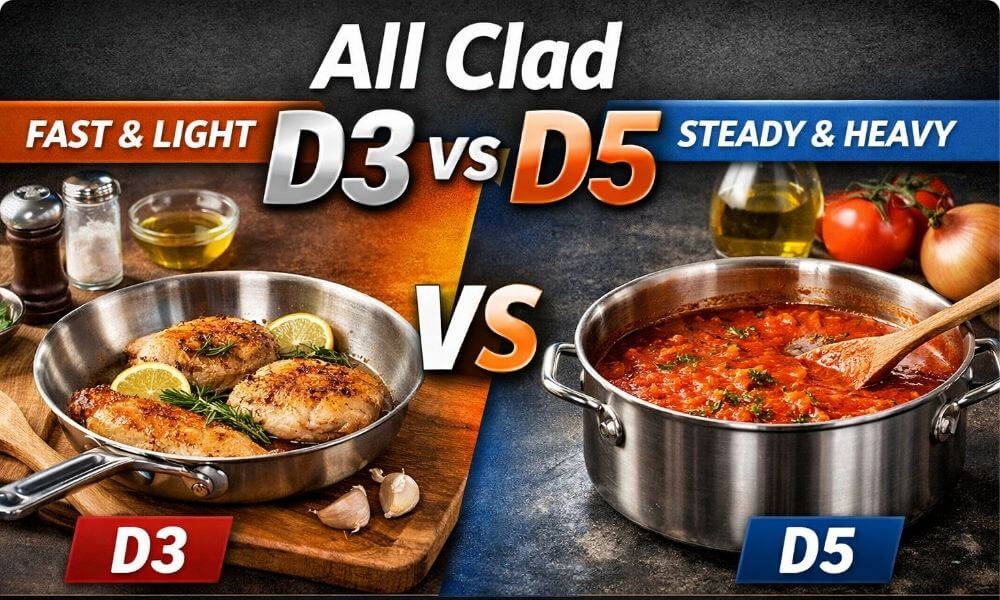
All Clad D3 is the better choice for most home cooks. It heats up fast, feels lighter in your hand, and usually costs less. For everyday cooking like eggs, vegetables, chicken, or rice dishes, it does the job very well.
All Clad D5 is better if you care more about cooking control than speed. It holds heat more steadily, which helps when cooking sauces, curries, or foods that need slow, gentle heat.
Simple Decision Rule
👉 Cook fast, everyday meals → Choose D3
Great if you cook daily and want something easy to use.
👉 Cook slow dishes or sauces → Choose D5
Better if you cook foods that need steady, even heat.
👍 Honest Note
Both are high-quality cookware and can last many years.
D3 is easier to handle because it’s lighter.
D5 can feel heavy, especially if you cook a lot every day.
Key Differences All Clad D3 vs D5
| Feature | All Clad D3 | All Clad D5 |
| Ply Construction | 3-Ply (Stainless + Aluminum + Stainless) | 5-Ply (Alternating Stainless + Aluminum Layers) |
| Heating Speed | ⭐ Faster heating | ⭐ Slower but more controlled heating |
| Heat Evenness | Very good | Excellent (more uniform edge-to-edge heat) |
| Heat Retention | Good | Better (holds temp longer) |
| Weight | Lighter, easier to handle | Heavier, more premium feel |
| Cooking Control | Great for general cooking | Best for precision cooking & sauces |
| Forgiveness (Burn Risk) | Medium | Higher (more stable temp) |
| Best For | Daily cooking, beginners, value buyers | Enthusiasts, serious home chefs |
| Induction Compatible | Yes | Yes |
| Oven Safe | Yes (typically 600°F) | Yes (typically 600°F) |
| Dishwasher Safe | Technically yes (hand wash recommended) | Same |
| Price Range | Check Price From Amazon | Check Price From Amazon |
| Value For Money | ⭐⭐⭐⭐⭐ | ⭐⭐⭐⭐ |
Construction & Technology Differences

What Is D3 Construction?
All Clad D3 is made using three layers of metal pressed together into one solid piece. The outer and inner layers are stainless steel, and the middle layer is aluminum.
The aluminum core is important because it helps heat move quickly across the pan. This means the pan heats up fast when you turn on the stove.
From real cooking use, D3 feels responsive. When you lower the heat, the pan cools down fairly quickly too. That makes it easier to control when you are still learning stainless steel cooking.
The small downside is that fast heating can sometimes create hot spots if you cook on very high heat.

What Is D5 Construction?
All Clad D5 is built with five layers of metal instead of three. These layers alternate between stainless steel and aluminum.
The extra layers slow down how fast heat moves through the pan. This helps spread heat more evenly across the cooking surface.
In real cooking, D5 feels more stable. The temperature doesn’t jump up or down as quickly, which can help prevent burning when cooking delicate foods or sauces.
The trade-off is that it takes a little longer to heat up. The pan is also heavier, which some people may not like for daily cooking.
Does More Ply Actually Matter?
More layers don’t automatically mean “better.” It depends on how you cook.
In everyday cooking, many people won’t notice a huge difference. D3 already spreads heat well enough for most meals like frying eggs, cooking chicken, or sautéing vegetables.
Where extra layers help is with steady, low heat cooking. Foods like sauces, thick curries, or long simmer dishes can be easier to manage because the heat stays more even.
The honest truth is this: both cook very well. The difference is more about cooking style than quality.
Real Cooking Performance Test
Heat Speed Test — Which Heats Faster?
In normal kitchen tests, the D3 heats up sooner. That means a D3 pan gets hot quickly on the stove, so you can start searing or frying faster. This fast response makes it handy when you want quick browning or to rush a weekday meal.
The D5 takes a little longer to reach the same temperature. It warms more slowly because of its extra layers, which trade speed for steadier heat once it’s hot. That slower start is the trade-off you pay for stability.
Heat Evenness Test — Hot Spot Comparison
When checking for hot spots (areas that cook much faster than others), D5 usually wins by a small margin. The extra layers help smooth out temperature across the surface, so you get more even cooking from edge to center. That helps with things like simmering sauces without a center scorch.
D3 still does a very good job for most home cooking. In everyday pans, many cooks see nearly even results with D3 — the difference only becomes clear in careful side-by-side tests or with long, gentle cooking.
Sauce Cooking Test — Low Heat Stability
For low, steady simmering (think tomato sauce or slow-reduced gravy), D5 holds its temperature better. Once it’s up to heat, it resists sudden temperature drops or spikes when you add food, so sauces are less likely to catch or burn. That steadiness is useful for long cooks.
D3 works fine for most sauces too, but you may need to watch the heat more closely and adjust the flame more often. If you often cook long, slow sauces, you’ll feel the difference.
Searing Test — Steak and Chicken Performance
Both pans can give a great sear when you preheat them properly. D3’s quicker heat-up means it’s easier to get a hot pan fast for a good crust. D5, once hot, keeps surface temperature steadier when you add cold meat, so it can recover heat better and reduce the risk of the pan cooling too much mid-sear.
If you want a quick checklist for searing:
- Preheat the pan until a drop of water sizzles and dances.
- Pat meat dry, use moderate oil, and don’t crowd the pan.
D3 gets you to that sizzle faster; D5 keeps that sizzle steadier after you add food.
Weight, Handling & Daily Comfort
Fatigue Factor
In real kitchen use, the biggest difference you’ll feel is weight. D5 pans are usually a bit heavier because they have more metal layers inside. That extra weight can make them feel very solid, but it can also tire your wrist if you cook for long periods.
D3 pans are lighter and easier to lift, especially when tossing food or moving a full pan from stove to sink. For most home cooks, this makes daily cooking feel less tiring.
A small downside: lighter pans can feel slightly less “premium” or tank-like compared to D5. But for everyday cooking, many people actually prefer that lighter feel.
Storage
Both D3 and D5 use stainless steel and have similar shapes, so storage space is almost the same. The real difference is how heavy they feel when stacking or pulling from a cabinet.
If you store pans overhead or in deep drawers, D3 is easier to manage. D5 can feel bulky if you have multiple pieces stacked together.
Washing
There’s no big difference in cleaning. Both are stainless steel, dishwasher safe (though hand washing is better for looks), and safe for scrubbing.
The only small comfort difference is weight again. Washing a heavy D5 skillet in the sink can feel a bit awkward compared to a lighter D3, especially when wet and slippery.
Pour Control
Both D3 and D5 usually come with flared rims, which help liquids pour smoothly without dripping.
In real use, pouring control feels almost identical. The only time you might notice a difference is when pouring from a very full, heavy D5 pan — it just requires a little more wrist strength.
Price vs Value: Is D5 Worth The Extra Money?
Cost Per Year Analysis (Lifetime Cookware Angle)
If you spread the cost of good stainless steel cookware over its lifespan, the price difference often looks smaller than it feels at checkout.
High-end stainless cookware like All Clad is designed to last decades with normal home use. Many people realistically keep it 20+ years if they don’t abuse it. That’s why thinking “cost per year” is more useful than just looking at purchase price.
For example, D3 sets often cost hundreds less than D5. Some comparisons show roughly $800 vs $1000 for similar sets, or around 25% price difference depending on size and retailer.
If you divide that extra cost over 20 years, you’re talking about a small yearly difference — often less than the price of one restaurant meal per year.
The honest part: If you cook mostly normal home meals, you probably won’t see $200 worth of cooking improvement. Many comparisons say everyday results are very similar.
So value really depends on how you cook, not just how long the pan lasts.
When D5 Is Actually Worth It (Real Use Cases)
D5 usually makes sense when cooking control matters more than speed.
It has extra layers, which means slightly better heat holding and stability. That helps when you want steady, low heat instead of fast heat swings.
In real kitchens, D5 is often worth it if you:
- Cook sauces that burn easily
- Do slow simmer dishes
- Like very controlled searing
- Use gas or powerful induction often
- Want heavier, more “solid” feeling pans
Community feedback often says D3 is already ideal for most people, while D5 feels more like a premium upgrade. For example, one user noted D3 is “more ideal for the average person,” while D5 still feels worth it for serious buyers.
But here’s the balanced truth: If you cook fast weekday meals, stir-fries, eggs, or chicken most days, D3 usually gives you 95% of the performance for less money.
Who Should Buy All Clad D3
All Clad D3 is a good choice for people who want high-quality stainless steel cookware that is easy to live with day to day. It balances performance, price, and comfort in a way that works for most home kitchens.
It’s not the fanciest option in the lineup, but for many cooks, that’s actually a good thing. You get strong performance without paying extra for features you may never notice.
D3 makes the most sense for certain types of cooks.
Beginners: If you are new to stainless steel, D3 is easier to learn on. It heats quickly and reacts fast when you change the heat, which helps you understand how stainless pans behave.
The only thing to remember is to avoid blasting high heat until you get used to it.
Daily Cooks: If you cook most days — simple meals like eggs, vegetables, chicken, or rice dishes — D3 feels practical and easy to use. It doesn’t feel overly heavy, which matters when you cook often.
For busy families or quick weeknight meals, this usually feels like the right balance.
Value Buyers: If you want premium cookware but still care about budget, D3 usually gives strong performance for the money. Many people feel it delivers most of the cooking performance of higher-priced models.
The trade-off is that it doesn’t have the same heavy, ultra-premium feel some people like.
People Who Prefer Lighter Cookware: If you don’t like heavy pans, D3 is easier to lift, move, and wash. This matters more than most people expect, especially when the pan is full of food.
If wrist comfort or easy handling matters to you, this is a big plus.
Who Should Buy All Clad D5
All Clad D5 is a better fit for cooks who care more about control and consistency than speed or price. It’s built to feel solid and stable on the stove, which some people really value once they cook more advanced meals.
It’s not necessary for everyone, but in the right kitchen, it can feel like a long-term upgrade rather than just another pan.
D5 tends to make the most sense for certain cooking styles and buyers.
Enthusiast Cooks: If you enjoy cooking as a hobby and like improving your technique, D5 can feel more rewarding to use. The pan holds steady heat, which helps when you’re trying to cook more precisely.
The only drawback is the extra weight. If you cook for long periods, you may notice it.
People Who Cook a Lot of Sauces: If you make tomato sauces, cream sauces, or reductions often, D5 can help keep heat more steady. This can make it easier to avoid burning or scorching, especially on low heat.
It won’t magically fix bad heat control, but it can make slow cooking feel more forgiving.
Long Simmer Cooking: If you often cook foods that stay on the stove for a long time — like thick curries, stews, or slow braised dishes — D5 can feel more stable once it’s hot.
The trade-off is that it takes a little longer to heat up at the start.
Premium Buyers: If you like buying cookware once and keeping it for many years, D5 fits that mindset. It feels heavy, solid, and built for long-term use.
Just be honest with yourself. If you mostly cook quick meals, you may not fully use what you paid extra for.
Best Choice For Different Cooking Styles
Different cooking styles need different pan behavior. Some foods need fast heat. Others need steady, gentle heat for a long time.
Neither D3 nor D5 is “better” for everything. It really depends on what you cook most often.
Western Cooking
If you cook foods like steak, pasta sauces, sautéed vegetables, or pan-fried chicken, both D3 and D5 will work well. These foods usually don’t need extremely long, slow cooking.
In real kitchens, many people prefer D3 for this style because it heats faster and feels easier to move around the stove. This is helpful when you are switching between boiling, frying, and sautéing in one meal.
The small downside is you may need to watch the heat a little more carefully when cooking delicate sauces.
High Heat Cooking
If you cook with high heat often — like stir-frying, fast searing, or quick pan frying — D3 usually feels more natural to use. It gets hot faster, so you spend less time waiting for the pan to be ready.
It also cools down faster when you lower the heat, which can help prevent overcooking.
The trade-off is that very high heat can create hot spots if you don’t move food around or preheat properly.
Curry, Sauce, or Slow Cooking
If you cook thick curries, long-simmer sauces, or dishes that stay on low heat for a long time, D5 can feel more stable once it’s heated. The temperature changes more slowly, which can help prevent burning during long cooking.
This can be helpful if you often cook foods that need steady heat for 30–60 minutes or longer.
The honest downside is that D5 takes longer to heat up at the beginning, so quick meals may feel slower to start.
Pros & Cons
All Clad D3 — Pros & Cons
Pros
✔ Faster heating — great for daily cooking
✔ Lighter weight — easier to handle and wash
✔ Usually cheaper than D5
✔ Excellent searing performance
✔ Great entry point into premium stainless cookware
✔ Heats up quickly on gas + induction
Cons
✖ Less heat retention than D5
✖ Can develop hot spots if heat is too high
✖ Slightly less forgiving for sauce cooking
✖ Doesn’t feel as “luxury heavy” as D5
Best For
👉 Daily home cooking
👉 Beginners learning stainless steel
👉 Value-focused buyers
👉 People who prefer lighter pans
All Clad D5 — Pros & Cons
Pros
✔ More even heat distribution
✔ Better heat retention for slow cooking
✔ More forgiving temperature control
✔ Premium heavy, professional feel
✔ Excellent for sauces, reductions, long simmer dishes
✔ Less temperature fluctuation when adding food
Cons
✖ More expensive
✖ Heavier (can be tiring for daily cooking)
✖ Slightly slower to heat up
✖ Overkill for simple daily meals
💡 Best For
👉 Serious home cooks
👉 Sauce and curry cooking
👉 Low-and-slow cooking methods
👉 Buyers wanting “buy once, use forever” cookware
Common Buyer Mistakes
Thinking “more layers = always better”
More metal layers can help with heat control, but they don’t magically fix every cooking problem. People sometimes pay extra for layers they’ll never notice in daily use. Instead of assuming more = better, match the pan to how you actually cook.
Ignoring weight and handling
A heavy pan might feel sturdy, but it can be tiring to lift, stir, or pour from every day. Many buyers regret not trying the weight first. If possible, pick up the pan in a store or compare weights online and imagine lifting a full pan of food.
Buying based only on brand
Big names are helpful, but brand alone doesn’t guarantee the right pan for you. Reviews, real cooking tests, and warranty info matter more than the logo. Look at real user experiences, not just polished product pages.
Skipping real-world testing info
Specs don’t tell the whole story. If a review only lists numbers, it may miss how the pan behaves when you actually cook. Read or watch tests that show real dishes being made, not just lab measurements.
Forgetting about maintenance and storage
Some pans need more careful cleaning or take up more space. Buyers often overlook how a pan fits their kitchen routines. Think about where you’ll store it and how much work washing it will be after a busy night.
Not checking return policies or warranties
A costly pan is an investment; make sure you can return it if it doesn’t suit you. Also check warranty terms—some sellers void warranties if you buy from unauthorized retailers.
Quick checks to avoid buyer’s regret
- Try lifting a similar pan in the store.
- Read a few long-form reviews that cook real food.
- Check the return policy and warranty.
Being thoughtful up front saves money and hassle later. Choose what actually fits your cooking style and kitchen habits, not just what sounds impressive on paper.
Care & Maintenance Differences
Cleaning Difficulty
Both D3 and D5 are stainless steel, which means they can be a little sticky if food isn’t cooked at the right temperature. Neither pan is hard to clean, but hand washing is usually better for keeping them shiny. Using soap, warm water, and a soft sponge works well.
D5’s extra weight can make scrubbing or handling a full pan slightly more cumbersome than D3, especially if you’re washing it in a sink.
Stain Resistance
Both pans resist stains fairly well. Fingerprints, water spots, or minor discoloration can appear, but they usually wipe off easily. Acidic foods like tomatoes or vinegar may leave temporary marks, but these don’t affect cooking performance.
D5’s thicker layers sometimes make it easier to maintain an even shine over time, but it’s a subtle difference.
Longevity Expectations
Both D3 and D5 are built to last decades if cared for properly. Stainless steel doesn’t chip like nonstick, and these pans can survive years of daily use.
Small wear is normal—minor scratches or dulling may happen over time—but it won’t affect how the pan cooks. D5’s heavier construction may make it slightly more durable under rough handling, but D3 still performs well for long-term use.
Read more: 3 Ply vs 5 Ply Cookware
Frequently Asked Questions (FAQs)
Is D5 safer than D3?
Not exactly. Both D3 and D5 are made from stainless steel and are safe for everyday cooking. D5 can feel a bit more stable because it holds heat evenly, which may help prevent food from burning, but neither pan is inherently “safer” than the other.
Does D5 last longer?
Both pans are built to last decades with normal use. D5 is heavier and slightly thicker, which can make it more durable if it’s handled roughly, but D3 also holds up extremely well over time. Proper care—hand washing when possible and avoiding overheating—will help either pan last for years.
Is D3 enough for home cooking?
Yes. D3 provides excellent performance for most home cooks. It heats quickly, handles daily meals easily, and is lighter to lift. For everyday cooking like frying, sautéing, or simmering, D3 is more than enough.
Do chefs use D3 or D5?
Professional chefs may use both, depending on the dish and kitchen setup. D5’s heat stability is helpful for long-cooked sauces or delicate dishes, while D3 is lighter and faster to heat, making it practical for many quick tasks. At home, D3 often covers most needs, while D5 is a premium option for precision cooking.
Final Verdict: Which Should You Buy?
For most home cooks, All Clad D3 is the smarter choice. It heats up quickly, is lighter to handle, and performs well for everyday meals like eggs, vegetables, chicken, or pasta. You get excellent stainless steel performance without spending extra for features you may never need. The only small downside is that it doesn’t hold heat quite as evenly as D5, but for daily cooking, this usually isn’t a problem.
If you do a lot of precision cooking, like long-simmer sauces, curries, or delicate dishes that need very steady heat, All Clad D5 can be worth the extra cost. It heats more slowly but holds temperature better, helping prevent burning or uneven cooking. The trade-off is its weight and higher price, which may not be necessary for most kitchens.