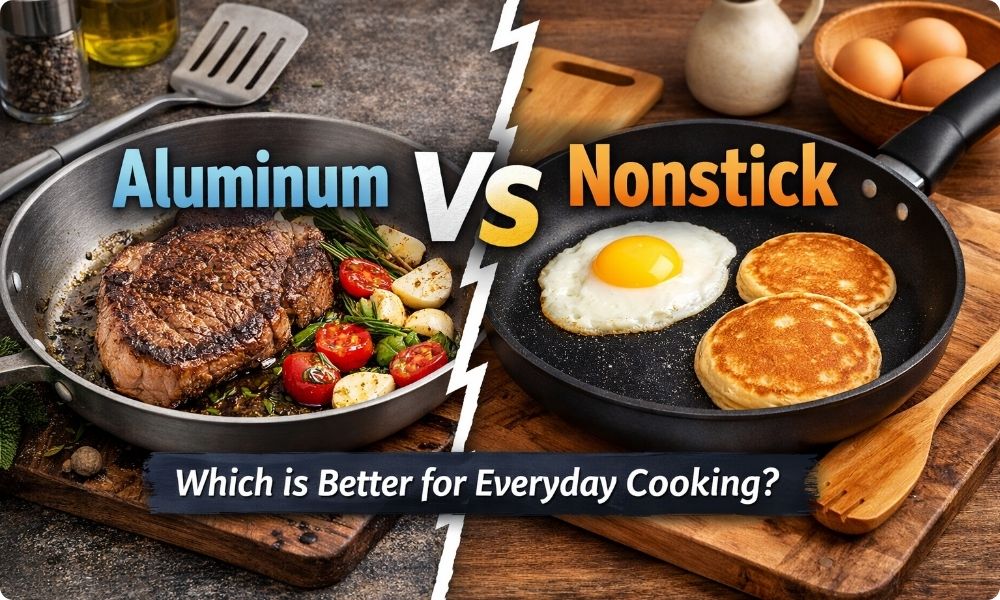
Aluminum vs Nonstick Cookware: Which Is Better?
When you walk down the cookware aisle, it’s easy to feel overwhelmed. Should you grab a shiny aluminum pan or stick with a nonstick skillet? The choice isn’t just about looks—it affects how your food cooks, how easy cleanup is, and even how long your pans last.
In this guide, we’ll break down aluminum vs nonstick cookware in a simple, honest way. You’ll learn the differences, the pros and cons of each, and which type works best for your cooking style. By the end, you’ll have the confidence to pick the right pan without guesswork or frustration.
What is Aluminum Cookware?
Aluminum cookware is made from aluminum metal, which heats up very quickly.
That means food starts cooking faster and more evenly compared to many other pans.
Because aluminum is lightweight, these pans are easy to lift and move around.
This is one reason they are popular in home kitchens and professional kitchens alike.
Most aluminum cookware today is treated or coated to make it stronger and safer for everyday cooking.
Types of Aluminum Cookware
- Plain (uncoated) aluminum — simple and light. Often found in very affordable pans.
- Anodized aluminum — aluminum that’s been treated to make the surface harder and less likely to react with food.
- Aluminum with a coating — aluminum base with a nonstick or enamel layer on top. You get the heat benefits of aluminum with a different cooking surface.
- Clad or layered pans — aluminum is sandwiched between other metals (like stainless steel) to combine strengths of each metal.
Key Features of Aluminum Cookware
- Very light — easy to lift and flip, which helps for everyday cooking.
- Heats up fast — it responds quickly when you change the burner temperature.
- Good heat spread — heats evenly across the cooking surface, so food cooks more uniformly.
- Affordable options — you can find decent aluminum pans at lower prices.
- Different finishes available — from untreated to hardened or coated surfaces, so performance and care needs vary.
Pros and Cons of Aluminum Cookware
Pros
- Fast, responsive heating makes it easy to control cooking.
- Lightweight and easy to handle for most people.
- Often less expensive than heavier metals.
- Works well as a base for nonstick coatings or layered cookware.
Cons
- Plain aluminum can react with very acidic foods and may change the taste or color slightly.
- Cheap aluminum can dent or warp with heavy use or very high heat.
- Coated versions can wear out—the coating may scratch or lose its nonstick power over time.
- Not all aluminum is dishwasher-safe; some types last longer with gentle care.
What Is Nonstick Cookware?
Nonstick cookware has a smooth surface that keeps food from sticking.
This makes cooking and cleaning much easier, especially for things like eggs and pancakes.
The nonstick layer sits on top of a metal base, so the pan still heats like a normal pan but food slides off more easily.
Types of Nonstick Cookware
- PTFE (often called Teflon): A very effective nonstick coating. Modern versions are made without the older chemical PFOA and are safe when used as directed.
- Ceramic-coated: A softer, often marketed “natural” coating. It releases food well at lower temperatures but can lose its nonstick ability faster than PTFE on some pans.
Both types work well for low- and medium-heat cooking, but they behave differently if you push the temperature very high.
Key Features of Nonstick Cookware
- Food releases easily, so you need less oil or butter.
- Cleaning is fast—usually a quick wipe or gentle wash will do.
- Ideal for delicate foods that break apart easily.
- Usually lightweight and simple to handle.
- Most nonstick pans are best used at low to medium heat.
These features make nonstick pans convenient for quick, everyday meals.
Pros and Cons of Nonstick Cookware
Pros
- Cooks sticky foods with almost no fuss, so beginners feel confident.
- Saves time on cleanup—great for busy nights.
- Helps reduce added fat because food won’t cling to the surface.
- Lightweight pans are easy to lift, flip, and store.
- Good for low-heat cooking like eggs, crepes, and reheating leftovers.
Cons
- The coating can wear off over time, especially with heavy use.
- Not made for very high-heat cooking—overheating can damage the surface.
- Metal spatulas and rough scrubbing shorten the pan’s life.
- Some cheaper nonstick pans lose their “nonstick” quickly.
- Once the surface flakes or peels, it’s time to replace the pan.
Aluminum vs Nonstick: Side-by-Side Comparison
Below is a clear look at how aluminum and nonstick cookware compare across the things readers care about most.
| Criteria | Aluminum (especially anodized) | Nonstick (PTFE or ceramic) |
| Heat conductivity | Excellent — fast & even | Good (base often aluminum) |
| Best cooking uses | Searing, browning, high-heat frying | Eggs, pancakes, low-fat cooking |
| Safety concerns | Plain aluminum can react with acidic foods; anodized reduces this | PTFE safe at normal temps; avoid overheating; ceramic has different durability |
| Durability | High for anodized; resists scratches and warping | Moderate — coatings wear with time |
| Ease of cleaning | Generally easy; may need scrubbing for stuck food | Very easy; usually wipes clean |
| Maintenance | Can handle metal utensils (anodized); dishwasher-safe depends on finish | Use wood/nylon utensils; hand wash recommended |
| Price & value | Wide range; good long-term value for quality anodized | Wide range; premium nonstick can be pricey but still replace sooner |
This table is a quick snapshot. The best choice depends on what and how you cook.
Cooking Performance in Real-Life Scenarios
High-Heat Cooking
If you sear steaks, stir-fry on high, or need rapid browning, aluminum — and especially anodized aluminum — is a clear winner. It tolerates higher temperatures and gives good, even contact with the food, so you get better browning and a good crust.
Delicate Foods
For eggs, pancakes, omelets, and other delicate items, nonstick shines. It allows you to cook these foods with little or no fat and they come right off the pan. If you make eggs several times a week, a reliable nonstick pan will save time and frustration.
Everyday Family Cooking
For one-pan family dinners, sautéing vegetables, or simmering sauces, both types can work. An aluminum pan gives you more flexibility and durability if you often move between high and medium heat. A nonstick pan makes cleanup faster, which helps on busy weeknights.
Many households benefit from owning one of each: a reliable nonstick for eggs and quick jobs, and an anodized aluminum or stainless pan for heavier cooking.
Safety & Health Considerations
Is Aluminum Cookware Safe for Daily Use?
For most home cooks, aluminum cookware used as intended is safe. The biggest improvement in recent years for aluminum cookware is anodizing, which creates a hard, non-reactive surface.
Anodized pans do not leach aluminum into food the way untreated metal can with acidic dishes. Simple care — avoiding extremely abrasive cleaners and using gentle utensils when needed — keeps the surface intact.
Is Nonstick Cookware Toxic?
Nonstick coatings, particularly older generations that used PFOA, caused concern in the past. Today, reputable manufacturers produce PTFE coatings that are PFOA-free, and they are generally safe when used at normal cooking temperatures.
The important safety practice is not to overheat an empty nonstick pan on high heat; this is when coatings can break down. Ceramic nonstick coatings are often marketed as a safer alternative, but they can chip or lose release more quickly depending on quality.
Which Is the Safer Option Overall?
Both can be safe with proper use. If safety is your main concern:
- Choose anodized aluminum if you want a metal pan that doesn’t react with food.
- Choose PFOA-free PTFE nonstick and follow temperature limits and care instructions if you want easy release.
- Avoid overheating any pan and replace cookware that shows flaking, deep scratches, or other signs of breakdown.
A practical safety tip: keep a small inexpensive thermometer near the stove if you’re worried about pan temperature. Most home cooking rarely exceeds the safe range for modern nonstick coatings, so careful use is usually all that’s needed.
Durability, Lifespan & Maintenance
How Long Aluminum Cookware Lasts
Anodized aluminum can last many years if cared for. It resists scratching, warping, and pitting better than untreated aluminum. You may notice cosmetic discoloration over time, but this usually doesn’t affect performance. For longevity:
- Avoid abrasive cleaners and steel wool.
- Use moderate heat rather than blasting pans on max heat.
- Follow manufacturer instructions about the dishwasher — some anodized pans are dishwasher-safe, but hand washing extends life.
How Long Nonstick Cookware Lasts
Nonstick coatings typically have a shorter lifespan than a good anodized aluminum pan. Depending on usage and quality, expect a nonstick pan to perform well for 1–5 years. High-quality nonstick pans with thicker coatings and careful care can last longer. To extend life:
- Use wooden or nylon utensils.
- Avoid metal spatulas and aggressive scrubbing.
- Don’t heat an empty pan on high for long periods.
- Replace pans once the coating becomes noticeably scratched, flaky, or loses release.
When to Replace
Replace any cookware when it shows signs of serious surface damage: flaking, deep gouges, warped bottoms, or coating loss. These signs reduce performance and may pose hygiene or safety concerns.
Cost vs Value: Which Saves More Money Over Time?
A cheap pan today that needs replacing every year can cost more in the long run than a higher-quality pan that lasts for a decade. Consider these points:
- Initial cost: Nonstick pans are available at all price points. Higher-end nonstick often costs more but may offer better coating durability. Anodized aluminum pans often cost more than entry-level nonstick but typically last longer.
- Replacement frequency: Nonstick pans generally need replacing sooner. If you cook frequently and rely on nonstick for many tasks, you might replace them more often.
- Long-term ownership cost: If longevity and versatility matter, a quality anodized aluminum pan often gives better value. If convenience and light cooking are your priorities and you accept occasional replacement, nonstick might be the better short-term choice.
A practical way to decide: estimate how often you cook and what you cook. For daily, high-heat cooking, invest in durable cookware. For light, casual use, a good nonstick can be more economical.
Read More: Stainless Steel Cookware vs Aluminum: Which Is Better
Which One Should You Choose? (Decision Guide)
When people ask me which cookware is better, my answer is almost always the same: it depends on how you cook. I’ve seen home cooks struggle with the “wrong” pan, even when the pan itself was good. The key is matching the pan to your habits, not forcing yourself to cook a certain way.
Let me walk you through it in a simple, real-life way.
Choose Aluminum Cookware If This Sounds Like You
If you enjoy cooking and like a pan that responds quickly, aluminum often feels right.
Maybe you turn the heat up and down as you cook.
Maybe you like browning food and building flavor in the pan.
Aluminum works well when:
- You cook on medium to high heat most of the time
- You want food to brown nicely instead of steaming
- You don’t want to worry too much about babying the pan
- You prefer something that can last for years with normal care
The small trade-off is that aluminum pans may need a bit more cleaning effort when food sticks. It’s not hard, but it’s something to expect.
Choose Nonstick Cookware If This Feels More Like You
Some people just want cooking to be easy. If that’s you, nonstick makes sense.
You may cook quick meals before work or make eggs almost every morning.
You probably don’t want to scrub pans after a long day.
Nonstick is a good choice when:
- You cook simple meals and don’t use very high heat
- You want food to slide out of the pan easily
- You care more about fast cleanup than deep browning
- You’re new to cooking and want fewer mistakes
The downside is that nonstick pans don’t last forever. You’ll likely replace them after a few years, even if you take good care of them.
If You’re Still Not Sure, Here’s the Honest Answer
In most real kitchens, one pan is not enough.
Many experienced home cooks keep:
- One aluminum pan for heavier cooking
- One nonstick pan for eggs and quick meals
This setup covers almost everything without stress. You don’t have to choose sides—you can let each pan do what it’s best at.
A Simple Rule to Remember
If you care more about how food cooks, go with aluminum.
If you care more about how easy cooking feels, go with a nonstick.
That one thought helps people make a decision without overthinking it.
Read More: Stainless Steel Cookware vs Non-Stick: Which Is Right for Your Kitchen?
Best Aluminum and Nonstick Cookware Options
Instead of brand-heavy recommendations, focus on the features that make a pan worth buying. Look for these when shopping.
What to look for in aluminum cookware
- Anodized finish: Harder surface, less reactivity, better durability.
- Thick base: Prevents warping and improves heat retention.
- Flat, even bottom: Good contact with the stove prevents hot spots.
- Good handle attachment: Riveted or solid stainless handles feel sturdy.
- Warranty or brand reputation: Manufacturers that stand behind products often offer better quality.
What to look for in nonstick cookware
- PFOA-free coating: Modern safety standard; most reputable brands follow this.
- Multiple-layer coatings: Thicker, multi-layer PTFE coatings last longer.
- Reinforced base: A strong base (often aluminum) ensures even heating.
- Temperature guidance: Look for clear manufacturer instructions about safe heat ranges.
- Repair/replace policy: Some companies offer good warranties on coatings.
Avoiding low-quality traps
- Ultra-cheap pans often have thin metal and weak finishes that warp and degrade quickly.
- Very cheap “ceramic” coatings may lose release fast. If ceramic is important, pick a well-reviewed model with a solid warranty.
- Don’t assume price alone guarantees quality; read reviews and check warranty terms.
Frequently Asked Questions (FAQ)
Is anodized aluminum better than nonstick?
Anodized aluminum is better for high-heat cooking and durability. Nonstick is better for low-fat cooking and cleanup. They serve different needs, so “better” depends on how you cook.
Can aluminum cookware be nonstick?
Yes. Many nonstick pans use aluminum as the base metal and then add a nonstick coating. That combines aluminum’s heat performance with nonstick convenience.
Which cookware is better for health?
Both can be safe. Anodized aluminum reduces metal reactivity, and modern nonstick coatings are PFOA-free. Avoid overheating nonstick pans and replace pans with damaged surfaces.
Can nonstick pans be used daily?
Yes, with care. Use moderate heat, avoid metal utensils, and hand wash when possible to extend their life.
Which is better for gas vs electric stoves?
Both types work on gas and electric. For electric and induction (if compatible), choose a pan with a flat, thick base for steady contact and even heating. For induction specifically, ensure the pan has a magnetic base or is labeled induction-ready.
Final Verdict: Aluminum vs Nonstick
There’s no universal winner. If you want a single recommendation: buy based on how you cook. For most home cooks, owning one high-quality anodized aluminum pan and one reliable nonstick skillet gives the best balance of performance, convenience, and value. Use the anodized pan for searing, browning, and heavier cooking, and the nonstick for eggs, pancakes, and quick, low-fat meals.
Be mindful of care: treat coated pans gently, avoid overheating, and replace cookware when surfaces degrade. That simple approach keeps both safety and cooking quality high.