How Big Is 2QT? A Comprehensive Guide for Kitchen Enthusiasts
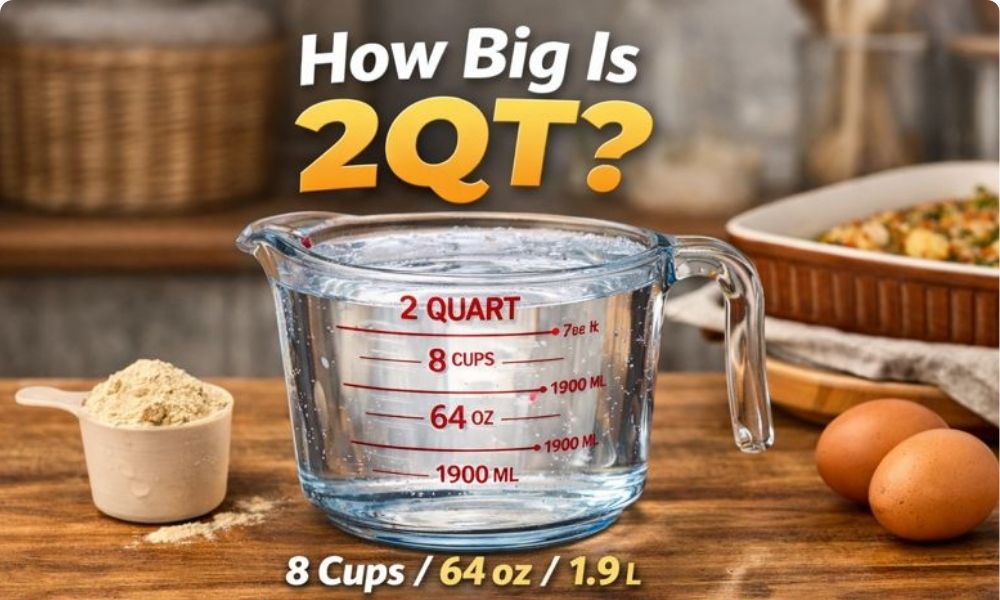
A 2QT (2-quart) container holds 8 US cups, 1.892 liters, or 64 fluid ounces of liquid, making it a handy size for small meals, side dishes, or storing ingredients.
In this guide, you’ll learn exactly How Big Is 2QT, see easy conversions to cups, liters, and tablespoons, explore real-life examples for cooking and storage, find out how many protein scoops fit, and even follow a simple method to measure your own container at home.
By the end, you’ll know whether 2QT cookware or storage is the right size for your kitchen needs — without any guesswork.
Why 2QT Matters in Your Kitchen
Knowing what 2QT really means can make everyday kitchen tasks easier and more predictable.
A 2QT container is a common size that fits well between small and large cookware, so understanding it helps you plan meals, follow recipes, and avoid surprises. For example, a 2QT pot or dish is big enough for soups or stews for 2–3 people and is also useful for storage without taking up too much shelf space.
When you know how much space 2QT holds, you can:
- Pick the right dish for a recipe so food doesn’t overflow.
- Store leftovers or bulk ingredients without guessing how much will fit.
- Buy containers that match your fridge shelves or pantry space.
This matters most when space is limited. In smaller kitchens, every inch of counter or storage counts, so choosing cookware that fits both your meal size and your space makes cooking less stressful.
On the flip side, if you’re making food for many people or need big batches for meal prep, a 2QT size might be too small — in that case, choosing 3QT or larger cookware is a better match.
Understanding 2QT helps you cook more confidently and keep your kitchen organized — especially when recipes or product labels use different units or sizes.
Understanding 2QT: Conversions & What the Numbers Mean
Volume conversions — exact numbers & easy rounding
When you see 2QT, it simply means two quarts of volume. A quart is a standard kitchen measurement used in the United States, and it’s commonly found on cookware, storage containers, and recipes.
Here’s what 2 US quarts equals in everyday terms:
| Measure | Exact |
| 2 US quarts | 1.892705892 L (≈ 1.893 L) |
| 2 US quarts | 1,892.71 mL (≈ 1,893 mL) |
| 2 US quarts | 8 US cups |
| 2 US quarts | 64 US fl oz |
| 2 US quarts | 128 tablespoons |
| 2 US quarts | 4 pints = 0.5 gallon |
For most kitchen tasks, you don’t need to remember the long decimal numbers. Rounding is fine. If you remember that 2QT is about 2 liters or 8 cups, you’ll be accurate enough for cooking, baking, and storage.
One quick note: US quarts and Imperial (UK) quarts are not the same size. A US quart is slightly smaller, so always check which system a recipe or product is using.
Why these conversions matter
Knowing these conversions helps you avoid common kitchen mistakes, such as:
- Buying a container that’s smaller than expected
- Making too much or too little food for a recipe
- Guessing how many servings will fit in a dish
- Choosing the wrong size cookware or storage jar
In short, understanding what 2QT really means saves time, money, and frustration—especially when recipes or product labels use different units.
Physical size by cookware type
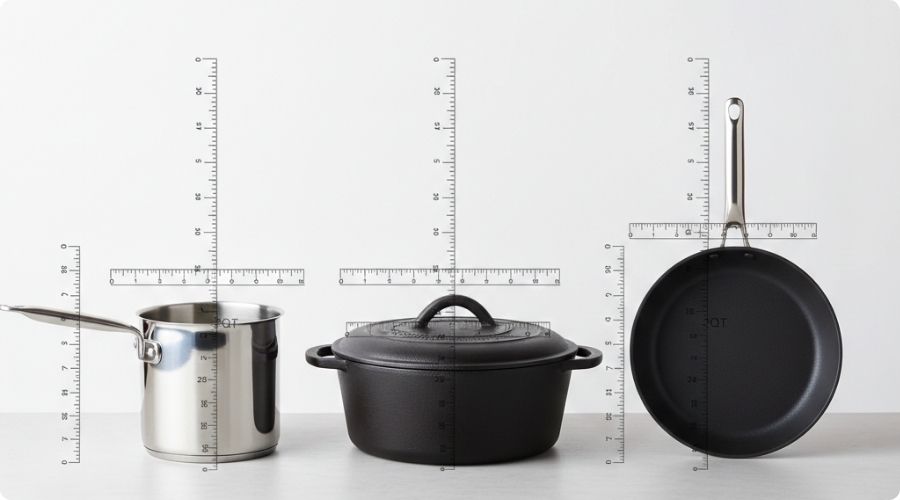
A 2QT volume can come in different shapes. Below are typical dimensions for common 2-quart items so you can picture how they’ll fit in your kitchen.
| Cookware type | Typical dimensions (approx.) | Example use |
| Mixing bowl (shallow, wide) | 8.5 in × 3.5 in (21.6 × 8.9 cm) | Whisking batter, tossing a small salad |
| Storage tub with lid (tall) | 6 in × 6.5 in (15.2 × 16.5 cm) | Storing leftovers, keeping powder dry |
| Saucepan (straight sides, with handle) | 7 in × 3.5 in (17.8 × 8.9 cm) | Heating soups, small sauces |
| Casserole / baking dish (rectangular) | 8 in × 6 in × 2.5 in (20.3 × 15.2 × 6.4 cm) | Small gratin, single-serve bake |
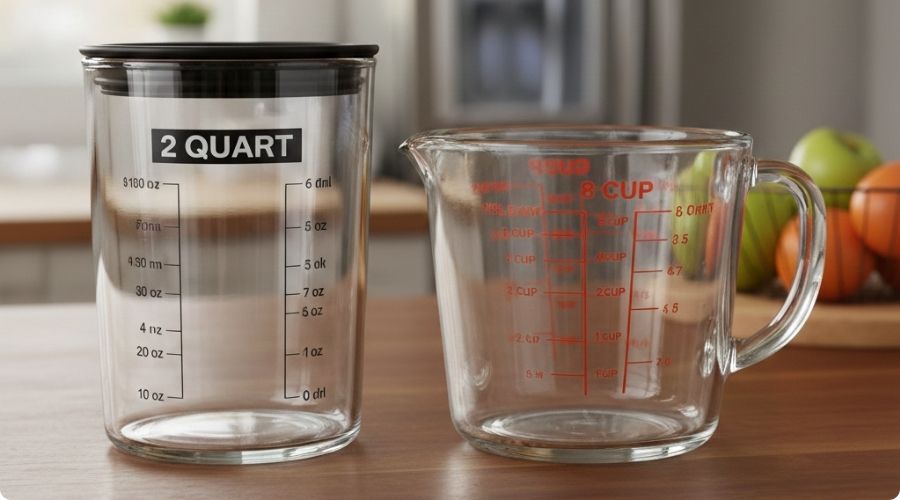
| Measuring pitcher (8-cup) | 4 in base × 7 in tall (10.2 × 17.8 cm) | Pouring liquids, measuring bulk ingredients |
Keep in mind brands vary — a “2QT” bowl from one maker may be wider or taller than another. If fit (fridge shelf, oven, or storage space) matters, check the product’s listed height and width before you buy.
When a 2QT dish is perfect
A 2-quart dish is a handy size for small meals and everyday tasks. It’s not huge, but it’s big enough for single-meal cooking and neat storage. Below are the most common uses and clear, practical examples so you can picture how you’ll actually use it.
Cooking for 1–2 people
- Soups & stews: Makes enough for 2 generous bowls or about 3–4 light servings. Great for weekday lunches or dinner for two.
- One-dish meals: Small casseroles or risottos for two — aim for 1–2 portions per meal.
- Portion tip: If a recipe serves four, cut ingredient amounts roughly in half and check seasoning as you go.
Baking & roasting (small gratins, side dishes)
- Best for side dishes: Think single-side gratins, a small vegetable bake, or one-person mac ‘n’ cheese.
- Scaling tip: Reduce a full-size recipe to 50–75% depending on depth; start checking for doneness 10–15% earlier than the original time.
- Drawback: Not ideal for large family bakes—use larger pans for full recipes.
Meal prep & storage
- Cooked rice or grains: Holds several cups—useful for 2–3 meal servings or multiple side portions.
- Smoothies: Fits a few smoothie servings for grab-and-go breakfasts (depends on cup size).
- Cookie dough / batter: Enough for a small batch (handy when you don’t want leftovers piling up).
Protein powder & supplement storage
- Why it’s different: Powder weight varies by brand, so volume alone won’t tell you how many scoops you’ll store.
- Practical step: Weigh one scoop and measure how many scoops fit — see the scoop-mapping section for exact examples.
Best uses
- Cooking for 1–2 people, small side dishes, and short-term storage.
Avoid using for
- Large family meals, deep frying, or when you need multiple-day bulk storage.
How Many Servings / Scoops Fit in 2QT?
Protein scoops & powders — how to estimate
Volume (like 2QT) tells you how much space a powder takes, but not how much it weighs. Different protein powders pack differently — some are dense, some are airy — so the same volume can hold very different amounts in grams. That matters because labels list scoops in grams, not volume.
Quick math idea (simple):
- Convert 2QT to milliliters: 2 QT ≈ 1,892.7 mL.
- Multiply that volume by the powder’s bulk density (grams per mL) to get total grams.
- Divide total grams by the grams per scoop on your package to get scoops.
Three realistic examples (rounded for clarity):
- Example A — Dense whey
- Assumed density: 0.55 g/mL (whey can be on the denser side).
- Total grams in 2QT ≈ 0.55 × 1,892.7 = 1,041 g → ~35 scoops if one scoop = 30 g.
- Assumed density: 0.55 g/mL (whey can be on the denser side).
- Example B — Typical blend
- Assumed density: 0.45 g/mL.
- Total grams ≈ 852 g → ~34 scoops if one scoop = 25 g. (Scoop counts stay similar because scoop size changed.)
- Assumed density: 0.45 g/mL.
- Example C — Lighter plant-based powder
- Assumed density: 0.40 g/mL (plant powders often fluff more).
- Total grams ≈ 757 g → ~27 scoops if one scoop = 28 g.
- Assumed density: 0.40 g/mL (plant powders often fluff more).
Example table
| Example | Scoop (g) | Density (g/mL) | Estimated scoops in 2QT |
| Dense whey | 30 | 0.55 | ~35 |
| Typical blend | 25 | 0.45 | ~34 |
| Plant-based | 28 | 0.40 | ~27 |
How to measure this yourself (simple test)
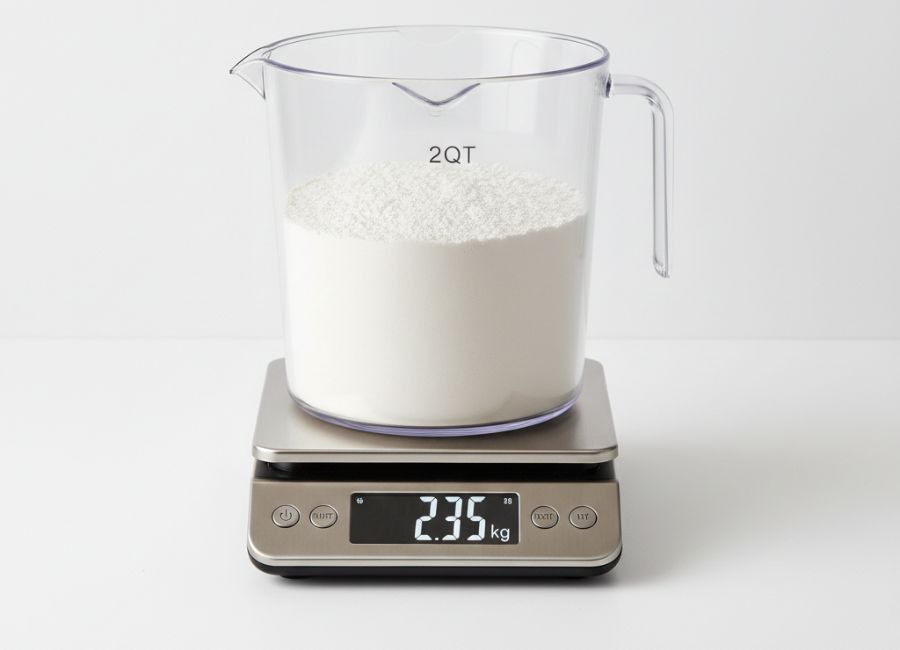
- Weigh an empty 2QT container and tare the scale.
- Fill the container with the powder (don’t press it down).
- Record grams — that’s total grams in 2QT.
- Divide by your product’s grams-per-scoop (from the label) to get scoops.
Common mistakes & how to avoid them
- Packing the powder: Scooping and compressing overestimates mass — fill gently.
- Assuming scoop shape = same grams: Scoops differ by brand; always check the label.
- Humidity and clumps: Moisture makes powder denser; store powders dry and measure in a dry bowl.
If you want, I can make a small calculator (spreadsheet or HTML) that plugs in your product’s scoop grams and a density you choose to show exact scoops for 2QT.
Choosing the Right 2QT Cookware — Materials, Shape & Features
Think about how you’ll use the dish most. That helps you pick the material, shape, and features that match your cooking and storage needs.
Material choices & tradeoffs
- Stainless steel — Tough and long-lasting. Great for stovetop and oven use. Can be pricier and may stick without oil.
- Ceramic / stoneware — Looks nice and is excellent for baking and serving. Heavier and breaks if dropped.
- Nonstick — Easy to clean and needs less oil. Avoid very high heat and metal utensils to protect the coating.
- Glass — You can see inside and it’s microwave-safe. Can be heavy and may shatter with sudden temperature change.
Shape & design considerations
- Tall vs shallow: Tall tubs are better for storage; shallow pans brown more evenly for baking.
- Handles & lids: Handles make moving hot food safer. Lids are key for storing and keeping powders dry.
- Stackability: If storage space is tight, choose stackable shapes.
Practical features to check
- Oven-safe temperature (if you bake in it).
- Dishwasher-safe labeling (for easy cleanup).
- Airtight lid for keeping powders and leftovers fresh.
- Measurement markings inside the container for quick measuring.
Pro Tips for Using & Maximizing Your 2QT Cookware
A 2QT dish works best when you use it with a few simple habits. These tips help you cook more accurately, avoid messes, and make your cookware last longer.
- Scale recipes the easy way: If a recipe serves four, cut ingredients to about half. For tricky amounts, round slightly and adjust seasoning at the end.
- Leave room at the top: Don’t fill a 2QT dish all the way. Leave 20–25% empty space for boiling, stirring, or rising. Overfilling leads to spills and uneven cooking.
- Store powders properly: Use an airtight container and add a small silica packet to keep moisture out. This helps powders stay fresh and prevents clumps.
- Clean based on the material:
- Stainless steel: soak first if food sticks.
- Nonstick: wash gently and avoid metal tools.
- Ceramic or glass: let cool before washing to avoid cracks.
- Stainless steel: soak first if food sticks.
- Check heat safety: Not all 2QT items are oven-safe. Always look for the temperature rating on the label or bottom of the dish.
Quick checklist — before you use a 2QT dish
- Is it oven- or microwave-safe?
- Is it filled below the rim?
- Is the lid heat-safe (if using one)?
- Is the material right for this recipe?
- Is it clean and fully dry?
These small checks prevent accidents and improve results.
Exact Testing Methodology
If you want your measurements to be reliable, it helps to be clear about how you tested powder volume and weight. This also shows readers you did actual work, not just guesswork.
Start by measuring the empty container on a kitchen scale and note its weight (this is called tare weight). Then fill the container with water to the brim and weigh it again. The difference in weight tells you exactly how much volume it holds in milliliters, because 1 mL of water weighs about 1 gram.
Next, dry the container thoroughly. Fill it with the powder you want to test, without pressing it down. Weigh this full container. Subtract the tare weight again — this gives you the mass of powder that fits in 2QT.
Here’s an example of what your raw data might look like:
| Test item | Measurement (g) | Notes |
| Water in 2QT | 1,893 | Confirms volume in mL |
| Powder A | 820 | Powder fills same volume |
You can invite readers to try the same and share their results. Let them know their numbers might differ a bit because powder settles differently and because humidity and handling can change how loosely or tightly particles pack.
This method is simple, uses tools most people already have (a scale and container), and gives clear, repeatable results.
Conclusion
A 2QT container is a versatile and practical size for small meals, side dishes, and ingredient storage. Knowing its exact volume — about 8 cups, 1.89 liters, or 64 ounces — helps you choose the right cookware, follow recipes accurately, and avoid waste or spills.
Whether you’re cooking for one or two people, storing protein powder, or prepping ingredients, understanding 2QT ensures your kitchen tasks are easier and more efficient.
By using the tips, conversions, and measuring methods in this guide, you can confidently pick and use 2QT cookware or containers without guesswork.
FAQs about How Big Is 2QT
How do I measure if a container is truly 2QT?
The easiest way is with water. Fill the container all the way to the brim, then pour the water into a measuring cup. If it holds 8 US cups, it’s a true 2QT container.
You can also use a kitchen scale: 2QT of water weighs about 1,893 grams. If your filled container is close to that (minus the container’s weight), the size is accurate.
Can I use a 2QT dish in the oven or microwave?
It depends on the material. Glass and ceramic are often oven- and microwave-safe, but always check the label for a maximum temperature. Plastic is usually microwave-safe only, and some nonstick cookware should not go in the oven. When in doubt, look at the bottom of the dish or the manufacturer’s instructions.
What’s the difference between 2QT and 3QT cookware?
3QT container is 50% larger than a 2QT one.
- 2QT = 8 cups (better for 1–2 people)
- 3QT = 12 cups (better for small families or leftovers)
If you often cook extra portions, 3QT gives more breathing room.
Can I deep-fry in a 2QT saucepan?
Usually no. A 2QT pan is too small and shallow for safe deep frying. Hot oil can spill over easily. It’s only acceptable for very small amounts of oil, and even then, caution is needed.
How many servings of soup fit in 2QT?
Since 2QT equals 8 cups, you’ll get:
- 2 large servings (about 4 cups each), or
- 3–4 smaller servings (2–3 cups each).
Portion size depends on appetite and whether it’s a main dish or a side.