Are copper cookware safe?
Copper cookware is beloved for its beautiful sheen and exceptional heat control — but many home cooks wonder: are copper cookware safe for everyday cooking? In this in-depth guide, you’ll get clear answers, practical safety tips, and evidence from trusted sources so you can confidently use (or choose) copper cookware.
Whether you’re considering buying copper pots, have heirloom pans gathering dust, or want to understand the risks and benefits, this article walks you through everything with expert-grounded detail.
Quick Answer: Are Copper Cookware Safe?
Copper cookware can be safe — if it’s properly lined with a non-reactive metal such as tin or stainless steel and the lining is intact.
Unlined copper cookware or cookware with worn/damaged linings can allow copper to leach into food, especially acidic dishes, which can potentially cause health concerns.
Why this guide — who it’s for
This post is for home cooks, people inheriting vintage pans, buyers weighing the pros/cons of copper cookware, and anyone who wants clear, actionable advice on safety, inspection, care, and buying choices. If you typed “are copper cookware safe” into Google, you want a quick safety verdict plus the steps to inspect, use, or replace your pans — that’s exactly what follows.
Quick Safety Decision Box — Is Your Copper Cookware Safe?
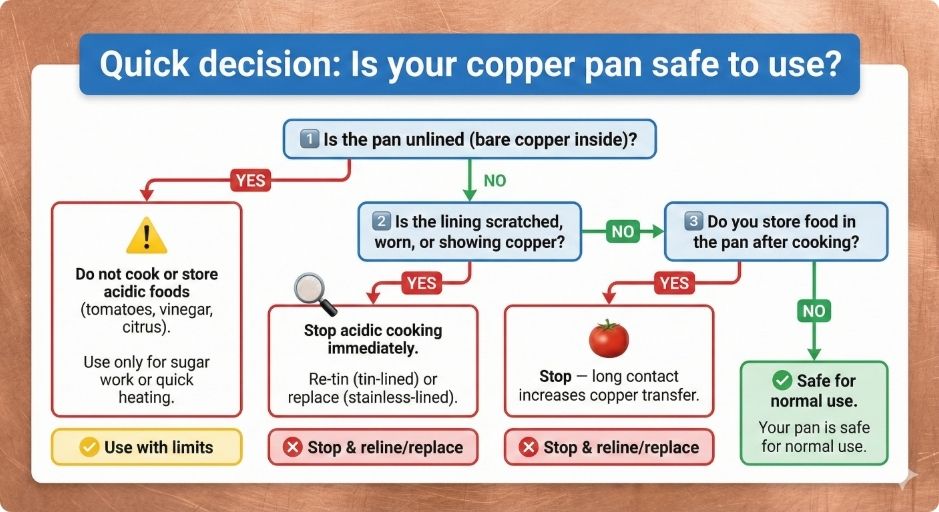
Copper Cookware Safety Checklist
✔ Interior is fully lined (tin or stainless steel)
✔ No copper showing through the lining
✔ No bubbling, flaking, or dark wear spots
✔ Not used for acidic foods if unlined
✔ Food is never stored in the pan
✔ Cleaned gently (no steel wool on tin lining)
✔ Pan is relined or replaced when lining wears
✔ Used at appropriate heat (avoid overheating tin)
How copper can get into your food
Copper metal itself is not ideal to eat in large amounts. When copper contacts acidic food or liquid, some copper ions dissolve into the food — the process is called leaching. Two key factors drive this:
- pH (acidity): Lower pH (more acidic) = more copper release. Foods like tomato sauce, citrus-based dressings, wine, or vinegar are the main concerns.
- Temperature and time: Higher temperatures and longer contact time increase copper transfer — simmering acidic sauces or storing acid food in copper pans raises exposure.
Regulators have studied copper intake from all sources and set safety benchmarks: EFSA concluded no copper retention is expected with an intake of up to ~5 mg/day (an ADI of ~0.07 mg/kg body weight), and judged typical population intakes stay below levels of concern — but the risk changes if cookware adds concentrated copper to food.
Read the science: what studies actually show about copper cookware safety
Scientific research on copper cookware focuses on how much copper migrates into food under different conditions and whether that exposure could exceed safe intake levels. The consensus across regulatory reviews and lab studies is consistent: copper migration is strongly influenced by acidity (pH), temperature, contact time, and whether the copper surface is lined.
EFSA guidance: how much copper is considered safe?
The European Food Safety Authority (EFSA) reassessed copper exposure from all sources (food, water, cookware, supplements) and established a tolerable daily intake (TDI) of ~0.07 mg per kg of body weight, which equals about 5 mg/day for an average adult. EFSA concluded that typical dietary copper intake alone does not pose a health concern for the general population. However, EFSA explicitly notes that localized, high copper exposure (for example, from copper cookware under certain conditions) can significantly increase intake and should be avoided .
This means copper cookware is not inherently dangerous — but specific cooking scenarios can push exposure beyond normal dietary levels.
What lab studies show about copper leaching
A key peer-reviewed study published in Food Additives & Contaminants examined copper release from lined vs unlined copper cookware using acidic food simulants (mainly 3% citric acid, comparable to tomato-based foods). Researchers measured copper migration at different temperatures and contact times.
Their findings were clear:
- Unlined copper released dramatically more copper than lined copper.
- Higher temperatures and longer contact times sharply increased copper release.
- Lined copper (tin or stainless) limited copper migration to very low levels under the same conditions.
Another study focusing on tin-lined copper cookware found that while tin itself can migrate into acidic food simulants at high temperatures, overall metal transfer remained far lower than from unlined copper, and risks were mainly associated with old, worn, or poorly maintained linings .
Measured copper release by pH and temperature (lab data)
| Cooking condition (3% citric acid) | Lined copper cookware | Unlined copper cookware |
| 4 °C (cold storage, 180 min) | ~0.6–3.0 μg/cm² | ~26.9–74.6 μg/cm² |
| 30 °C (room temp, 180 min) | ~1–6 μg/cm² | ~50–250 μg/cm² |
| 60 °C (hot, 180 min) | ≤3 μg/cm² | ~26.9–74.6 μg/cm² |
| 24-hour contact (unlined) | — | 78.7 μg/cm² (4 °C) → 407.4 μg/cm² (60 °C) |
Source: Koontz et al., PMC study on copper release kinetics
What this means for home cooks
From a safety perspective, these data support a practical conclusion:
- Properly lined copper cookware keeps copper exposure far below EFSA’s safety thresholds.
- Unlined or damaged copper cookware, especially when used with acidic foods and heat, can contribute meaningful copper exposure and should be avoided for those uses.
In short, the science does not suggest panic — it supports smart use, proper lining, and routine inspection as the key factors that make copper cookware safe in real kitchens.
Which linings are available — pros & cons
Tin-lined copper (traditional):
- Pros: Great heat feel and traditional nonstick-like surface for sauces; repairable (can be re-tinned).
- Cons: Soft, wears with use and aggressive scrubbing; tin or its impurities can also migrate in some conditions (studies show higher Sn in acidic simulants and potential impurities in old tins). You may need professional re-tinning every several years depending on use.
Stainless-lined copper (modern):
- Pros: Durable, low-maintenance, no need for relining; often preferred for everyday cookware.
- Cons: Lining cannot be re-tinned if damaged; stainless lining reduces the pure “feel” of copper vs tin.
Unlined copper:
- Pros: Useful for specific tasks (sugar work, candy; or to quickly heat water).
- Cons: Reactive with acidic foods and beverages — avoid using for sauces, tomatoes, citrus, vinegar-based cooking, or storage.
Practical inspection & maintenance checklist (what to do now)
If you own copper cookware, follow these steps:
- Inspect the interior: Look for scratches, bubbling, exposed copper, or areas where the lining has thinned. If copper shows through, stop cooking acidic foods in that pan.
- Do a quick acid test (visual): Add a small amount of lemon juice or tomato to the cold pan and check for rapid discoloration or metallic taste (don’t taste the food if you suspect contamination) — discoloration or quick color change suggests reactivity. (Use caution; this is a visual check, not a precise lab test.)
- Avoid storing food: Never store acidic food in copper. Remove food promptly.
- Use proper cleaning methods: For tin-lined pans — gentle dish soap, soft cloths, avoid metal scrubbing pads and high heat. For stainless-lined — more robust cleaning is okay, but avoid scratching the lining. Use recommended polish for exteriors.
- If the lining is compromised: For tin-lined pans, get a professional re-tinner (re-lining) estimate. For stainless-lined pans with deep damage, replacement is usually necessary.
When to repair vs replace — practical thresholds
- Minor wear (thin spots but no copper exposure): Monitor and avoid acidic cooking; you may get years more use.
- Obvious copper exposure (shine or greenish copper color inside the pan): Stop cooking acidic foods immediately — repair (re-tinning) if pan is valuable or sentimentally important. Re-tinning costs vary widely by region and pan size — often several tens to a few hundred dollars.
- Severely damaged stainless lining: Replacement is usually more cost-efficient than relining — stainless liners can’t be “repaired” the same way tin can.
Buying guide — which copper pan to choose
- If you want classic performance & will maintain it: Tin-lined copper (for sauce work) — good for chefs who cherish copper’s responsiveness and will re-tine when needed.
- If you want copper look but low maintenance: Stainless-lined copper (best everyday choice).
- If you want the copper effect affordably: Copper-clad (tri-ply) stainless cookware or clad stainless with copper exterior offers similar heat distribution with less risk and maintenance.
Health context — how big is the real risk?
EFSA’s assessment concluded typical intakes of copper from food and non-food sources do not pose a concern for the general EU population, and they set an Acceptable Daily Intake (ADI) of about 0.07 mg/kg body weight (≈ 5 mg/day for an average adult) — but that does not excuse concentrated contamination from cookware. The risk from cookware is situational: hot, acidic, long contact with unlined or damaged copper is what can push exposure higher.
Bottom line: normal use of properly lined copper is safe. Problems occur with unlined copper or damaged lining combined with acidic, hot, or prolonged contact.
Read More: Stainless Steel Cookware vs Copper
Is Copper Cookware Safe Compared to Other Materials?
| Cookware Type | Safety | Maintenance | Reactivity |
|---|---|---|---|
| Stainless Steel | Very High | Low | Non-reactive |
| Cast Iron | High | Moderate | Mildly reactive |
| Copper (Lined) | High | Moderate | Non-reactive |
| Copper (Unlined) | Low | High risk | Highly reactive |
Copper isn’t unsafe by default — misuse is the problem, not the material itself.
FAQ — Copper Cookware Safety
Are copper cookware safe?
Yes — when lined and the lining is intact. Copper cookware is safe for everyday cooking if the interior is tin- or stainless-lined and shows no signs of wear or exposed copper.
Is unlined copper cookware safe for cooking?
Not for acidic foods; limited specialized uses only. Unlined copper is fine for sugar work or brief heating, but avoid cooking or storing acidic foods in it.
How can I tell if my copper pan is worn?
Look for scratches, bubbling, flaking, or exposed copper. Any visible copper or blistering inside the pan is a sign to stop acidic cooking and consider repair.
Can copper from pots make you sick?
High copper intake can cause stomach upset and toxicity. Typical diets aren’t a problem, but concentrated leaching from unlined or damaged cookware can raise short-term exposure.
How often should tin-lined copper be relined?
Depends on use; often every few years with heavy use. Frequency varies — inspect regularly and reline when the tin thins, flakes, or copper shows through.
Are stainless-lined copper pans safer than tin-lined?
Both safe when intact; stainless needs less maintenance. Tin gives classic performance but wears; stainless is more durable and avoids regular relining.
Can I store food in copper cookware?
No — never store acidic food in copper pans. Extended contact (especially acidic foods) increases metal transfer — transfer food to safe, nonreactive containers for storage.
What should I do if I see copper inside the pan?
Stop using it for food and seek repair or replacement. If interior copper is visible, stop cooking acidic foods in that pan immediately and either have it re-tinned or replace it.
Conclusion — Is copper cookware safe?
Copper cookware is safe when properly lined and maintained. Tin or stainless linings prevent harmful copper transfer, while unlined or damaged pans can pose risks with acidic foods.
Regular inspection, gentle cleaning, and timely relining or replacement keep your cookware safe and effective.
Choose the lining that fits your cooking style, avoid storing acidic foods in copper, and enjoy the performance and beauty copper brings to your kitchen.