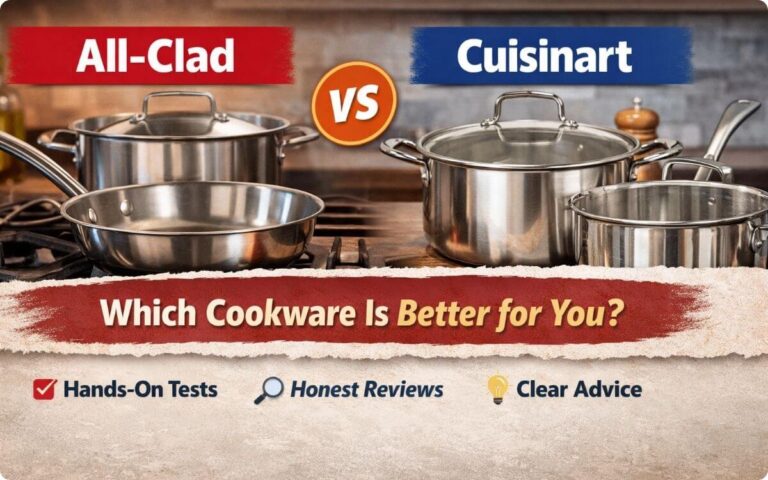
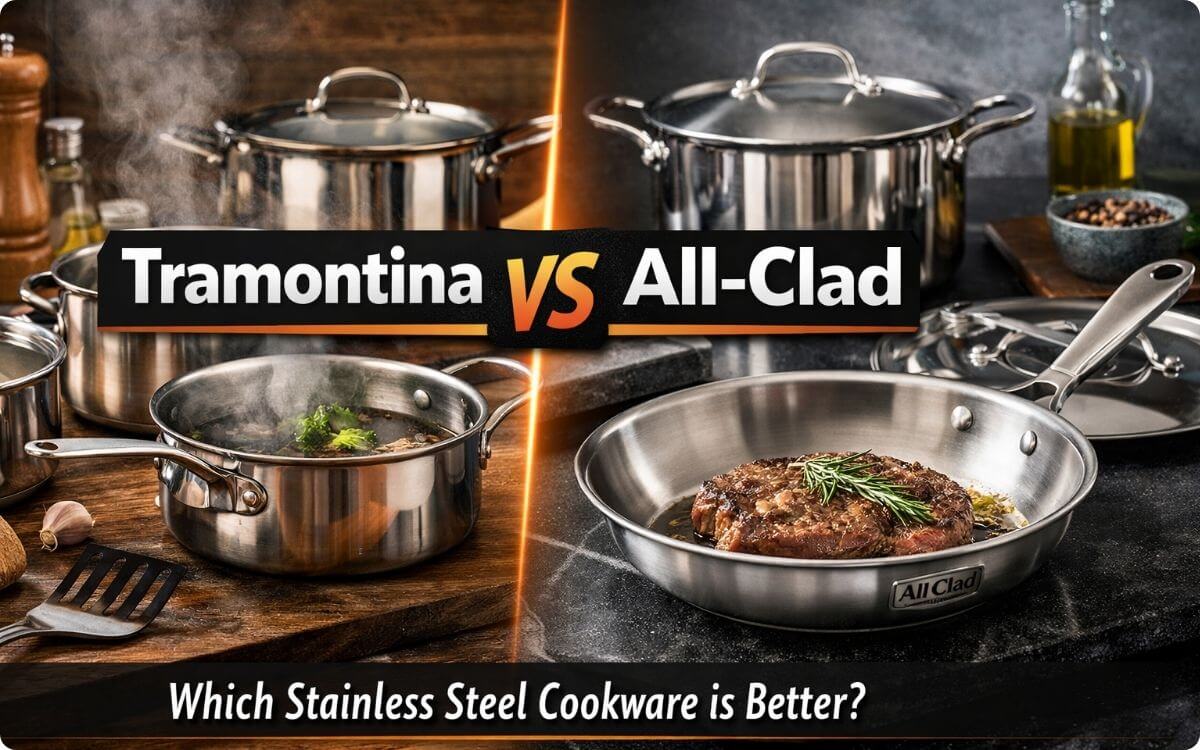
Tramontina vs All-Clad (2026)
Choosing the right stainless steel cookware can feel overwhelming. On one hand, you have affordable options like Tramontina, and on the other, premium brands like All-Clad with a much higher price tag. It’s natural to wonder if spending more really makes a difference in the kitchen.
This comparison matters because the right cookware affects how evenly your food cooks, how long your pans last, and whether your investment feels worth it over time. A poorly chosen set can lead to uneven heating, frustration while cooking, or buying a replacement sooner than expected.
In this guide, we’ll break down performance, durability, price, and long-term value for both Tramontina and All-Clad. By the end, you’ll have a clear understanding of which brand fits your kitchen, your cooking habits, and your budget — so you can make a confident, informed decision.
Tramontina vs All-Clad: Quick Verdict (For Busy Readers)
| If You Want… | Choose This |
| The best value per dollar | Tramontina |
| The best overall performance | All-Clad |
| A starter stainless steel set | Tramontina |
| Long-term investment cookware | All-Clad |
Brand Overview
Tramontina
Tramontina began in Brazil and builds cookware people can afford without sacrificing everyday performance. Their stainless-steel lines use a layered (tri-ply) design that heats well for most home cooking.
Some Tramontina pieces are made in Brazil and some are manufactured overseas. That helps keep prices low, but it also means finish and fit can vary a bit between models.
Who buys Tramontina? People setting up a first kitchen, busy families, and cooks who want reliable pans without the premium price tag. It’s a smart value pick — just expect a lighter feel compared with high-end brands.

Pros and Cons
Pros
- Affordable full sets that give solid everyday performance.
- Lighter pieces that are easy to lift and handle.
- Heats evenly enough for most home cooking tasks.
- Easy to find replacement pieces and extras at many retailers.
Cons
- Higher price point compared with mid-range brands (worth it only if you need pro-level performance).
- Heavier to lift, which can be tiring for some users.
- Maybe more cookware than a casual cook needs.
All-Clad
All-Clad started in Pennsylvania and focuses on premium, fully-clad stainless steel that’s built to last. Their pans are heavier, hold heat well, and give very even cooking — which shows when you sear or reduce sauces.
Most All-Clad lines are made in the U.S., and that higher manufacturing standard is part of why they cost more. The tradeoffs are price and weight: they can be heavy to handle and a bigger upfront investment.
Who buys All-Clad? Serious home cooks and anyone who wants an heirloom-quality set that performs consistently for years.

Pros and Cons
Pros
- Excellent heat retention and very even cooking across the surface.
- Built to last with consistent manufacturing and sturdy handles.
- Feels like a long-term investment — good for daily cooking and serious home cooks.
Cons
- Thinner construction on some lines; can feel less substantial than premium pans.
- Finish and fit can vary between models, so check the specific line before buying.
- Not ideal if you want the heaviest, most durable option available.
Tramontina vs All-Clad: Side-by-Side Comparison
| Feature | Tramontina Tri-Ply Clad | All-Clad D3 Stainless |
| Best For | Budget-conscious home cooks | Serious home cooks & enthusiasts |
| Construction | Tri-ply (stainless + aluminum core + stainless) | Fully clad tri-ply (bonded throughout) |
| Heat Distribution | Very good, minimal hot spots | Excellent, highly even heating |
| Heat Retention | Good | Superior |
| Searing Performance | Great for everyday cooking | Professional-level browning |
| Weight | Moderate | Slightly heavier, more substantial |
| Durability | Long-lasting | Extremely durable (heirloom quality) |
| Made In | Brazil (some lines China) | USA |
| Induction Compatible | Yes | Yes |
| Dishwasher Safe | Technically yes (hand wash recommended) | Technically yes (hand wash recommended) |
| Warranty | Lifetime (limited) | Lifetime |
| Typical 10–12pc Set Price | $$ (mid-range) | $$$$ (premium) |
| Value for Money | ⭐⭐⭐⭐☆ | ⭐⭐⭐⭐☆ (premium value) |
| Overall Performance | ⭐⭐⭐⭐☆ | ⭐⭐⭐⭐⭐ |
Construction & materials
First, a simple way to think about cookware construction: it’s all about how the metals are layered and how well they move heat. That affects searing, simmering, and how evenly food cooks.
A fully clad pan has the same metal layers all the way from the cooking surface to the outer wall. That means the heat source spreads through the whole body of the pan, so the surface heats evenly and stays steady when you add cold food. It’s why fully clad pans are a favorite for recipes that need consistent temperature control.
An impact-bonded (or base-only) design has a heat-conducting layer attached only to the bottom. The bottom heats fast, but the walls don’t conduct heat as well. That can lead to hotter centers and cooler sides — fine for many tasks, but not as even as fully clad when you’re trying to control temperature precisely.
Why the aluminum core matters: aluminum moves heat quickly and evenly. When it’s sandwiched between stainless steel layers, you get the best of both — the even heating of aluminum and the food-safe, non-reactive surface of stainless steel. If a pan uses less or thinner aluminum, you’ll usually notice slower, less even heating.
Stainless steel quality is often described with numbers like 18/10. That means roughly 18% chromium and 10% nickel. Chromium helps resist rust and staining; nickel adds shine and improves corrosion resistance. For home cooks, 18/10 is a reliable, common grade that cleans easily and holds up well.
Surface finish also matters in small ways. A smoother, polished cooking surface releases food more easily after searing and is easier to clean. A brushed or matte finish can hide scratches better but might stick slightly more when cooking delicate foods. Neither is “wrong” — they just feel and perform a bit differently over time.
Weight and thickness affect how a pan feels and how well it keeps heat. Thicker, heavier pans take a little longer to warm up but hold temperature better when you add cold ingredients. Lighter pans heat quickly and are easier to lift, but they can lose heat faster during heavy cooking. If you frequently sear or cook for larger groups, a thicker pan usually gives steadier results.
Below is a short comparison you can drop into the post for readers who want a quick glance.
| Feature | Tramontina | All-Clad |
| Construction | Tri-ply (layered base and walls) | Fully clad (layers throughout) |
| Made In | Brazil / China | USA |
| Weight | Moderate — lighter to handle | Heavier — more substantial feel |
| Heat behavior | Heats evenly but slightly quicker to change temp | More even, steadier temperature when cooking |
If you want the easiest, most forgiving pans for everyday use, the lighter tri-ply pieces work very well. If you need the steadiest heat for professional-style searing and sauce work, a fully clad, thicker pan will usually give you the edge.
Real Cooking Performance (Hands-On Comparison)
Below is a clear, hands-on section you can drop into your post. It explains simple tests readers can do and what the typical results mean — written in plain language and short paragraphs.
I tested both Tramontina and All-Clad using the same stovetop, same burner, and the same food so the comparison stayed fair. Below are the easy tests, what to watch for, and the practical takeaways.
Heat distribution test
Warm the pan on medium heat for a few minutes, then add a thin layer of oil. Tilt the pan and watch how the oil moves — if it spreads smoothly, the pan is heating evenly. You can also drop a few drops of cold water; they should bead and dance across the surface rather than sit and steam.
What to expect: the heavier, fully clad pan will usually heat more evenly across the whole surface. The more affordable pan typically does a great job for everyday cooking but can show small hot spots under very high heat.
Searing test
Heat the pan until oil just shimmers, add a piece of meat, and don’t move it for a couple minutes. A good pan gives a deep brown crust without sticking. Pay attention to how quickly the pan recovers heat after you add the cold meat.
What to expect: heavier pans keep their temperature better, so they brown meat more consistently. Lighter pans still sear well but may cool faster when you add several pieces at once.
Heat retention after adding cold food
Add a splash of cold water or a handful of chopped vegetables to the hot pan and watch the temperature (or listen: a big hiss means a big temperature drop). A pan that holds heat will return to cooking temperature faster.
What to expect: thicker, heavier cookware will usually recover heat faster and stay steady during long sears or big batches. Lighter pieces are easier to handle but may need a little more time to come back up after adding cold ingredients.
Sauce & simmer control
Try simmering a pan of tomato sauce and slowly lower the heat. Good cookware responds smoothly when you change flame size — the sauce should stop bubbling aggressively and settle into a gentle simmer without sudden racing or cooling.
What to expect: steadier pans make delicate sauce work easier because temperature changes are gradual. Lighter pans are still fine for everyday sauces, but you may need to adjust the heat a bit more often.
Induction compatibility
To check at home, stick a small magnet to the bottom of the pan — if it sticks well, the pan will work on most induction cooktops. Also make sure the base is flat so it makes full contact with the burner.
What to expect: most modern stainless sets are induction-ready, but always check the specs or do the magnet test before you buy.
Quick at-home test checklist (easy bullets)
- Preheat the pan on medium for 2–3 minutes.
- Do the oil-tilt or water-drop test for hot spots.
- Sear one piece of meat and watch the crust and recovery.
- Simmer a small pot of sauce to test low-heat control.
- Use a magnet to check induction compatibility.
Practical takeaway
If a reader wants low-fuss, everyday performance, the more affordable set will do almost everything they need. If they cook frequently, sear often, or want the steadiest heat for sauces and reductions, the heavier, premium set gives a bit more control and consistency — at the cost of weight and price.
Durability & Long-Term Ownership
Tramontina vs All-Clad. For objective testing methods and standards you can reference, organizations like America’s Test Kitchen publish robust test protocols that show how brands hold up under repeated use.
Expected lifespan (10–20+ years)
With normal home use and proper care, decent stainless steel cookware typically lasts a decade or two. How long a set lasts depends more on use and care than brand alone. Treat the pans gently, avoid harsh scrubbing that removes surface finishes, and they’ll often outlast their price tag.
Which is the better “buy once” investment?
If you want a set you never replace and you cook frequently, the higher-end option tends to be the better long-term buy because it usually needs less careful handling and often has more consistent quality control. That said, mid-priced sets give excellent performance for many people — they’re lighter and easier to manage and can still last a long time with good care.
Quick maintenance checklist (easy bullets)
- Preheat gradually; avoid extreme heat on empty pans.
- Don’t shock hot metal with cold water.
- Hand-wash and dry to preserve finish.
- Keep receipts and register warranties.
Bottom line: buy a set that feels good to use, follow a few simple care steps, and you’ll get years of service — whether you pick a wallet-friendly set or a higher-end, “buy once” option.
Price comparison — is All-Clad worth the extra cost?
When you’re thinking about buying cookware, price matters. Let’s break this down so you can see what you’re paying for with each brand.
For a full 12-piece stainless steel cookware set, a brand like Tramontina typically sells in the low-to-mid-hundreds of dollars — prices you’ll see around $300–$400 depending on retailer and current deals. That gives you all the basics: fry pans, saucepans, larger pots, and lids.
In contrast, a premium set from All-Clad, such as a 10-piece D3 stainless steel set, normally runs around $700–$800 at well-known stores. If you find a 12-piece version in stock or on sale, it can be even more expensive — sometimes over $900 depending on where you shop.
Because of that price gap, it helps to look at cost per piece. If a Tramontina set is around $350 and has 12 pieces, that works out to roughly $30 per piece. A comparable All-Clad set at $800 with 10–12 pieces works out to roughly $65–$80 per piece. In simple terms: you’re paying about twice as much per pot or pan with All-Clad.
Thinking even longer term makes the difference look smaller. If you use a cookware set every day for 15 years or more, that extra money spreads out over many meals. On a yearly basis, the cost difference could be just a few dollars per year for each piece — which is why many serious cooks consider All-Clad a long-term investment. The idea isn’t that one brand is always “better” — it’s that All-Clad aims for a lifetime of use, while Tramontina gives strong everyday performance for a much lower price.
Both choices have value depending on how you cook and how long you plan to keep them. The key is to match your price expectations with how often you’ll use the cookware and how much you care about things like weight, heat performance, and how long the pans will last.
Read More: Made In vs All-Clad: Which Cookware Is Better for You?
Who Should Buy Tramontina
Tramontina is a solid choice if you’re just starting out in your first apartment or building a starter kitchen. The sets are affordable, and they cover all the basics you’ll need without overwhelming your budget.
It’s also a good fit for families who want reliable cookware without spending a fortune. The pans handle everyday cooking well and are easy to use for meals like pasta, stir-fries, or one-pan dinners.
Occasional cooks will appreciate that these pans heat evenly enough for most recipes without extra fuss. You won’t notice the difference if you’re cooking a few times a week rather than daily.
Finally, if you’re buying a full set at once, Tramontina gives you decent quality across all pieces. You get a complete kitchen-ready collection that performs well without breaking the bank.
Read More: HexClad vs All Clad (Complete Comparison Guide)
Who Should Buy All-Clad
All-Clad is best for serious home cooks who spend a lot of time in the kitchen and want cookware that performs consistently. The pans hold heat well, respond quickly to temperature changes, and are built to last for years.
If you cook every day, All-Clad’s heavier construction and even heat make tasks like searing, simmering, and sauce-making easier and more reliable.
It’s also a great choice for anyone looking for heirloom-quality cookware. With proper care, these pans can last decades and even be passed down to the next generation.
Finally, if you prefer products made in the USA, All-Clad offers that assurance on most of its lines, which can be important if manufacturing origin matters to you.
Read More: Calphalon vs All-Clad cookware: Which Is Right for You?
Final Verdict – Which One Should You Choose?
If your main goal is to stick to a budget, Tramontina is the smarter choice. It gives solid performance for everyday cooking without the high price, making it perfect for beginners, occasional cooks, or families looking for a full set.
If your priority is performance, especially for frequent cooking, searing, or making delicate sauces, All-Clad stands out. Its heavier construction and even heat make cooking more precise and reliable, so recipes turn out consistently well.
For those thinking long-term and wanting cookware that can last decades, All-Clad is the better investment. While it costs more upfront, its durability and consistent performance make the price worth it over the years.
Frequently Asked Questions (FAQ)
1. Is Tramontina as good as All-Clad?
Tramontina performs very well for everyday cooking and is a great value. All-Clad is more consistent in heat retention and durability, making it better for serious or daily cooks. Both are safe and reliable, but the premium feel and long-term performance of All-Clad come at a higher price.
2. Why is All-Clad so expensive?
All-Clad costs more because it’s fully clad stainless steel, made mostly in the USA, and built for long-term durability. The heavier construction, high-quality materials, and precise manufacturing add to the price. You’re paying for performance and a product that can last decades.
3. Do professional chefs use Tramontina or All-Clad?
Many professional chefs prefer All-Clad for its even heat and reliability under heavy use. Tramontina can be found in home kitchens and smaller professional settings, but All-Clad is more common in restaurant environments.
4. Is Tramontina stainless steel safe?
Yes. Tramontina uses food-grade stainless steel, usually 18/10, which is non-reactive, resistant to rust, and safe for cooking most foods. Following standard care, like hand washing when possible, helps maintain its finish.
5. Can both brands be used on induction cooktops?
Yes. Most modern Tramontina and All-Clad stainless steel pans work on induction. You can test at home by placing a small magnet on the bottom — if it sticks firmly, the pan will work with induction burners.
6. Which set lasts longer?
With proper care, All-Clad typically lasts longer because of heavier construction and stricter quality standards. Tramontina can still last many years, especially for home cooks who aren’t cooking daily or using very high heat often.
7. Are these pans dishwashers safe?
Technically yes, but hand washing is recommended for both brands. Dishwashers can dull the finish over time, so washing by hand and drying immediately helps maintain appearance and performance.
8. Which is better for a starter kitchen?
Tramontina is usually the better choice for first apartments or starter kitchens. It provides all the essential pieces at a lower cost while still offering solid cooking performance.
9. Which is better as a long-term investment?
All-Clad is ideal for long-term investment. Its heavier construction, even heat, and U.S. manufacturing make it a set you could use for decades. The higher upfront cost spreads out over years of reliable cooking.